Why Growing SMEs in India Should Choose Odoo ERP
in 2026
India’s SME sector is no longer small. With over 7.8 crore registered enterprises contributing 31% of the country’s GDP and nearly 49% of total exports, MSMEs have become the backbone of India’s economic engine. Yet, a significant number of these businesses still run on disconnected spreadsheets, standalone accounting tools, and manual processes that worked five years ago but cannot sustain the growth they are experiencing today.
The gap is widening. As order volumes increase, customer expectations rise, and regulatory requirements like e-invoicing and GST become more stringent, growing SMEs face a critical choice: continue patching together fragmented tools, or adopt a unified ERP system that can grow with them.
This blog explains why Odoo ERP has emerged as the preferred choice for growing Indian SMEs in 2026 — not because it is the cheapest option, but because it offers the rare combination of enterprise-grade capability, modular flexibility, and a cost structure that does not punish businesses for scaling up.
The Real Problem: Why Growing Indian SMEs Struggle Without ERP
Most Indian SMEs do not start with an ERP. They start with Tally for accounting, Excel for inventory, WhatsApp for sales communication, and a shared folder for documents. This works when you have ten employees and fifty orders a month. It stops working when you have fifty employees and five hundred orders a month.
Here is what typically breaks first:
- Inventory blind spots — Stock levels in the spreadsheet do not match the physical warehouse. Overselling and stockouts become routine.
- Delayed financial visibility — The accounts team needs a week to produce monthly reports because data lives in five different systems.
- Manual order processing — Every purchase order, delivery note, and invoice is created from scratch. The same data is entered three or four times across different tools.
- Compliance scramble — GST returns, e-invoicing, and TDS calculations require manual reconciliation across systems that do not talk to each other.
- Scaling bottlenecks — Adding a new branch, warehouse, or product line means duplicating every manual process, increasing the risk of errors with every expansion.
These are not theoretical problems. They are the daily reality for thousands of Indian SMEs operating between ₹2 crore and ₹100 crore in annual revenue. The cost of not having an ERP is not a line item in any report — it shows up as lost orders, delayed deliveries, and exhausted teams doing work that software should be handling.
Why Odoo Stands Out for Indian SMEs
When evaluating ERP options, growing Indian SMEs need a platform that matches their pace, budget, and operational reality. Here are seven reasons why Odoo consistently emerges as the preferred choice.
1. Start Small, Scale Without Limits
Odoo’s architecture is modular. You do not need to buy the entire suite on day one. A trading company can start with just Accounting, Inventory, and Purchase, then add Manufacturing, HR, and eCommerce as the business grows. Each module integrates seamlessly with the others, so there is no data migration or re-implementation required when you expand.
Your ERP evolves at the same pace as your business — no costly re-implementations, no data migrations between phases, and no pressure to commit to modules you do not need yet.
2. Genuinely Affordable — Not Just on Paper
Odoo offers two editions:
- Community Edition — completely free and open source. For example, it is ideal for startups with in-house technical teams who can manage their own infrastructure.
- Enterprise Edition — a per-user subscription model with official support, cloud hosting, and advanced modules like Accounting, Studio, and mobile access.
In addition, for Indian SMEs, Odoo’s pricing is localized and designed to be accessible. A typical implementation project for an SME ranges from ₹4 lakh to ₹20 lakh depending on the number of users and customization required.
Moreover, the per-user subscription model means you pay only for what you use, and costs scale predictably as your team grows.
3. Built-In GST and India Compliance
For Indian businesses, regulatory compliance is not optional — in fact, it is an everyday operational requirement. Odoo 19’s India localization module covers:
- GST compliance — automatic CGST, SGST, IGST, and Cess calculation based on fiscal positions
- E-invoicing — direct integration with the NIC IRP portal for automated IRN generation
- E-way bills — generation and validation within the system
- GSTR filing — support for GSTR-1 and GSTR-3B report generation
- GSTR-2B matching — automatic reconciliation of Input Tax Credit against vendor bills
- TDS/TCS — automated calculation and configuration
As a result, this eliminates the separate compliance software that many SMEs currently pay for alongside their accounting tool.
4. One System for Everything
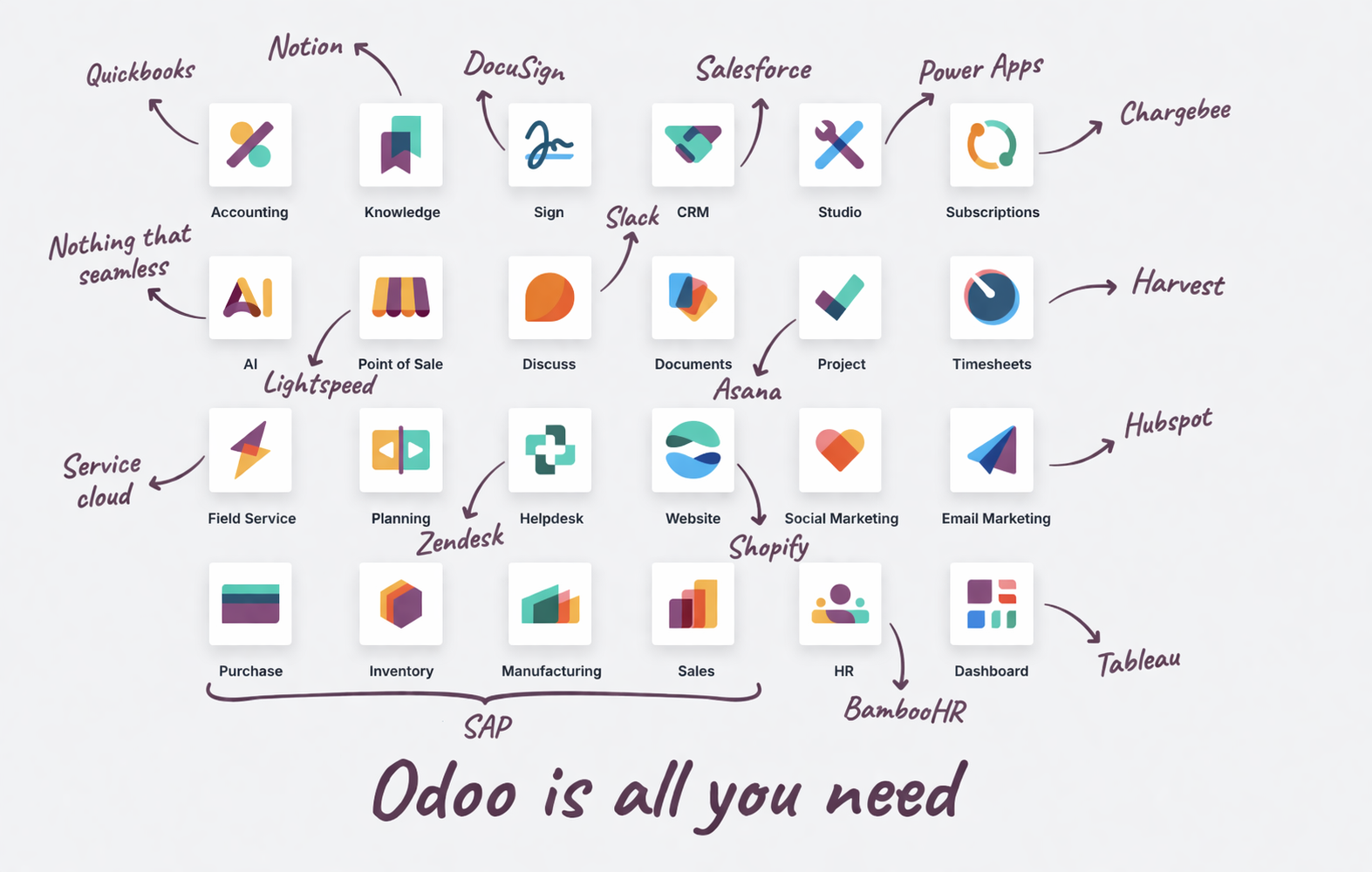
The most significant advantage of Odoo for a growing SME is not any single module — it is the fact that all 80+ modules share a single database. When a salesperson creates a quotation in the CRM, it can be converted to a sales order, which triggers an inventory reservation, generates a delivery order, creates an invoice, and updates the accounting ledger — all without anyone re-entering data.
Compare this to the typical Indian SME setup where sales data lives in one tool, inventory in another, and accounting in a third. The manual effort required to keep these systems synchronised is itself a full-time job.
5. AI-Powered Operations in Odoo 19
Odoo 19 introduced embedded AI capabilities across the platform:
- AI Agents in CRM, Accounting, Helpdesk, and HR that answer questions about your business data in natural language
- Smart Fields in Odoo Studio that auto-generate content based on record data
- Prompt-based automation — create complex server actions through natural language instructions without coding
- Meeting transcription, intelligent lead scoring, and SEO-optimised content generation for the website module
For SMEs that cannot afford dedicated data analysts or automation engineers, these built-in AI features provide capabilities that were previously available only to large enterprises.
6. Work from Anywhere, Anytime
Over 70% of new ERP deployments in India in 2025 were cloud-based, and for good reason. Cloud ERP eliminates the need for on-premise server infrastructure, reduces IT overhead, and allows teams to access the system from anywhere. As a result, businesses can operate more flexibly without heavy infrastructure investments
Odoo offers three hosting options: Odoo Online (fully managed cloud), Odoo.sh (platform-as-a-service for customized deployments), and on-premise for businesses with specific data residency requirements. In addition, the mobile app provides full access to key modules, allowing business owners to approve purchase orders, check inventory, and review dashboards from their phone.
7. A Global Ecosystem with Local Expertise
Odoo has over 12 million users worldwide and a wide network of certified implementation partners across India. This gives businesses the flexibility to choose a partner that aligns with their needs. At Infinitor Solutions, we help businesses implement and scale Odoo with solutions tailored to their needs.
Why Infintor Solutions Is the Right Odoo Partner for Indian SMEs
Infintor Solutions is an Official Odoo Partner in India, bringing years of dedicated experience to complex ERP implementations, customisation, and consulting for small and medium enterprises across various industries.
Infintor’s services cover the complete Odoo lifecycle, including:
Conclusion
For Indian SMEs in 2026, the question is no longer whether to adopt an ERP system — it is which ERP system matches the scale, budget, and compliance requirements of the business. Odoo 19 answers that question with a modular, affordable, and deeply India-compliant platform that grows alongside the business.
Frequently Asked Questions
1. Is Odoo ERP suitable for small businesses in India?
Yes. Odoo’s modular architecture allows small businesses to start with just the modules they need — such as Accounting, Inventory, and Sales — and add more as they grow. The Community Edition is free, making it accessible even for businesses with limited budgets.
2. How does Odoo compare to Tally for Indian SMEs?
Tally is an excellent accounting tool, but it is limited to financial management and basic inventory. Odoo is a full ERP covering CRM, Sales, Purchase, Manufacturing, HR, eCommerce, and more — all in a single integrated system. Businesses that have outgrown Tally’s capabilities are the ideal candidates for Odoo.
3. Is Odoo GST compliant in India?
Yes. Odoo Enterprise includes a comprehensive India localisation module with full GST support, e-invoicing, e-way bill generation, GSTR report generation, GSTR-2B matching, and TDS/TCS automation.
4. What is the cost of implementing Odoo for an SME in India?
Implementation costs vary based on the number of users, modules, and customisation required. A typical SME implementation ranges from ₹4 lakh to ₹20 lakh. The Community Edition has zero license fees, while Enterprise follows a per-user subscription model.
5. Can Odoo handle multi-branch and multi-warehouse operations?
Yes. Odoo natively supports multi-company, multi-branch, and multi-warehouse configurations. Each branch can have its own warehouse, chart of accounts, and reporting while consolidating data at the parent company level.
6. Do we need a partner to implement Odoo?
For most businesses, working with a certified Odoo partner is strongly recommended. A good partner ensures the system is configured correctly from the start, your data is migrated cleanly, your team is trained properly, and you have ongoing support as the business evolves. Getting the foundation right with an experienced partner saves significant time and cost in the long run.
Ready to explore what Odoo can do for your growing business? Contact our team for a free ERP consultation