
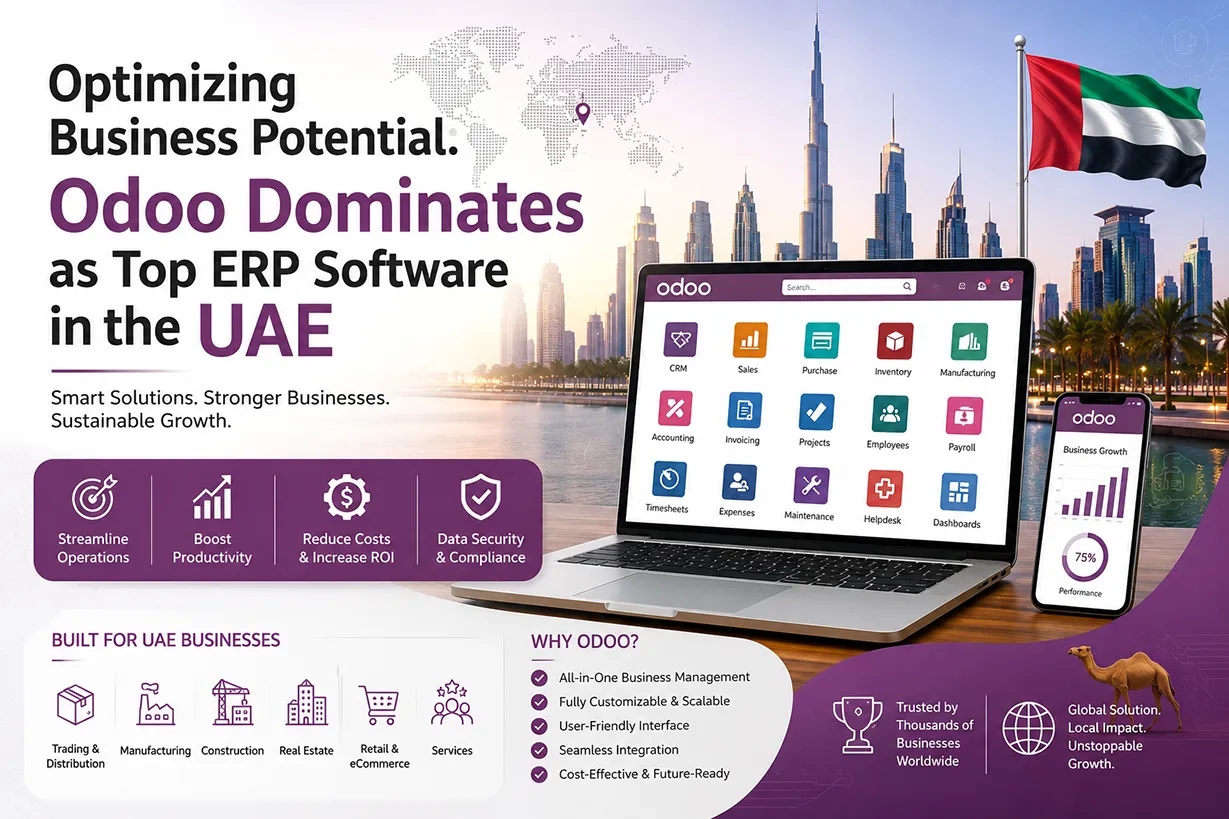
The UAE business environment continues to evolve rapidly as companies adopt digital technologies to improve productivity, control costs, and deliver better customer experiences. As a result, businesses increasingly look for ERP software in the UAE that can connect financial management, sales, customer relationship management, inventory, purchasing, human resources, manufacturing, and other essential operations through one centralized platform. Odoo ERP software in the UAE addresses this requirement by bringing multiple business functions together within an integrated and flexible environment.
For growing companies, disconnected systems can create unnecessary complexity. Employees may need to enter the same information into different applications, while managers may struggle to obtain accurate and timely reports. Odoo reduces these challenges by connecting business processes and centralizing operational data. Consequently, companies can improve visibility, reduce repetitive work, and make faster decisions. This integrated approach makes Odoo ERP a practical option for startups, small and medium-sized businesses, and established enterprises operating across the UAE.
Odoo ERP for UAE Businesses: Connecting Every Department
One of the major advantages of Odoo ERP is its ability to connect different departments through a single business management platform. Instead of maintaining separate applications for accounting, CRM, sales, purchasing, inventory, projects, and human resources, businesses can build an integrated Odoo environment based on their operational requirements. Moreover, companies can start with the applications they need today and expand the system as their business grows.
This flexibility is particularly valuable in the UAE, where businesses operate across highly competitive markets and often expand into new Emirates, industries, and international markets. With centralized information, management teams can monitor sales performance, inventory levels, customer activity, purchasing requirements, and financial information more efficiently. At the same time, employees can work with consistent information across departments, helping businesses reduce communication gaps and improve operational accuracy.
Odoo ERP Localization for UAE Businesses and VAT Compliance
Navigating the unique business landscape and regulatory requirements of the UAE demands ERP software that is not only powerful but also aligned with local regulations. Odoo rises to this challenge by offering localization features designed to support businesses operating in the United Arab Emirates. From VAT compliance to local accounting requirements, Odoo helps businesses manage their financial operations more efficiently while reducing the risk of errors and non-compliance. This localization capability makes Odoo ERP a strategic choice for companies looking for reliable ERP software in the UAE that can support their local business requirements.
Odoo Multi-Company and Multi-Currency ERP for UAE Businesses
In a country where businesses often operate through multiple companies, branches, Emirates, and currencies, ERP flexibility becomes essential. Odoo provides robust multi-company and multi-currency capabilities that allow organizations to manage diverse business operations through one integrated ERP platform. Whether a company operates across Dubai, Abu Dhabi, Sharjah, or other Emirates, or conducts international trade, Odoo can help simplify financial management, transactions, consolidation, and reporting. Therefore, businesses looking for scalable Odoo ERP software in the UAE can use its multi-company and multi-currency functionality to support expansion both within the UAE and internationally.
Odoo ERP Customization for Different Industries in the UAE
The UAE has a diverse economy that includes finance, real estate, construction, manufacturing, retail, hospitality, logistics, professional services, and many other sectors. Each industry has different operational requirements, which means businesses need an ERP solution that can adapt to their workflows. Odoo’s modular architecture allows companies to select relevant applications and customize the system according to their specific business processes. Whether a company needs Odoo for construction, manufacturing, retail, trading, hospitality, or professional services, the platform provides a broad range of applications that can be configured to meet industry-specific requirements. This flexibility makes Odoo customization an important advantage for businesses seeking an ERP solution in the UAE.
Odoo Inventory and Supply Chain Management in the UAE
The UAE plays an important role in regional and international trade, making efficient logistics, inventory, procurement, and supply chain management essential for many businesses. Odoo ERP integrates inventory management, purchasing, sales, warehouse operations, and order fulfillment within one connected platform. As a result, businesses can gain better visibility into stock levels, purchase requirements, incoming shipments, and customer orders.
For companies involved in trading, distribution, import, export, manufacturing, and eCommerce, effective inventory management can directly influence customer satisfaction and profitability. Odoo helps businesses organize warehouse operations, track inventory movements, manage replenishment, and improve order fulfillment. Consequently, Odoo supply chain management can help UAE businesses reduce operational delays, improve inventory accuracy, and create more efficient logistics processes.
Odoo CRM and Sales Management Software for UAE Companies
Customer relationships are crucial in the highly competitive UAE market. Businesses need an effective CRM system to capture leads, manage opportunities, track sales activities, and maintain strong relationships with customers. Odoo CRM provides a centralized platform where sales teams can manage leads and opportunities while gaining a clearer view of the sales pipeline.
From lead generation and opportunity management to quotations, sales orders, and after-sales activities, Odoo connects the complete sales process. Furthermore, integrating Odoo CRM with accounting, invoicing, marketing, and other business applications allows employees to access relevant customer information from one system. For companies searching for Odoo CRM in the UAE, this integrated approach can improve sales visibility, customer engagement, and overall business efficiency.
Odoo Cloud ERP for Flexible Business Management in the UAE
Modern businesses require access to critical information regardless of where their employees or management teams work. Odoo’s cloud-based deployment options provide businesses with flexible access to their ERP environment without relying entirely on traditional on-premise infrastructure. This flexibility can be particularly useful for UAE companies with employees, branches, management teams, or operations across different locations.
With cloud ERP, authorized users can access business applications and information according to their assigned permissions. Managers can review important business information, while employees can continue their daily operations without being tied to a single physical location. In addition, cloud-based ERP can make it easier for growing businesses to scale their systems as their operational requirements increase. Therefore, Odoo cloud ERP can provide UAE businesses with a flexible foundation for modern digital operations.
Odoo ERP Data Security and Business Information Protection
Data security is an important consideration when businesses select ERP software in the UAE. An ERP system manages sensitive information such as customer details, financial records, sales data, employee information, inventory records, and business transactions. Therefore, companies need appropriate access controls and security practices to protect critical business information.
Odoo provides user access controls, permissions, authentication mechanisms, and other administrative capabilities that organizations can configure according to their requirements. Businesses can define which users can access specific applications and functions, helping them establish controlled access to sensitive information. In addition, organizations should follow appropriate security practices for hosting, passwords, backups, user permissions, and system administration. When properly configured and managed, these capabilities can help businesses establish a more secure and controlled ERP environment.
Odoo Implementation and Support Services for UAE Businesses
Successful ERP implementation requires more than simply installing business software. Companies need proper planning, business process analysis, configuration, data migration, testing, employee training, and post-implementation support. Therefore, businesses adopting Odoo ERP in the UAE should work with an experienced implementation team that understands both Odoo and their specific business requirements.
Reliable Odoo support and maintenance can also help businesses get greater long-term value from their ERP investment. As business processes change, companies may require new applications, workflow improvements, integrations, custom reports, or additional automation. An experienced Odoo service provider can help organizations manage these changes while maintaining system stability. Consequently, professional Odoo implementation and support can play an important role in helping UAE businesses achieve their digital transformation goals.
Odoo Community and Professional ERP Support in the UAE
Implementing an ERP system can involve complex business and technical requirements, making reliable support an important part of the overall ERP strategy. Odoo has a large international ecosystem of users, developers, partners, and implementation specialists who contribute knowledge, solutions, and best practices. This ecosystem gives businesses access to a broad range of expertise as they implement and expand their Odoo environment.
For UAE companies, working with an experienced Odoo partner can provide additional assistance with implementation, customization, integration, training, migration, troubleshooting, and ongoing support. Local knowledge can also help businesses understand their operational requirements and configure Odoo accordingly. As a result, combining Odoo’s global ecosystem with professional local support can help businesses maximize the value of their Odoo ERP investment.
Odoo Accounting and VAT Management for UAE Companies
Financial management plays a critical role in the success of any UAE business. Companies need reliable accounting processes, accurate financial reporting, proper invoice management, and effective control over receivables and payables. Therefore, choosing ERP software in the UAE with strong accounting capabilities can significantly improve financial visibility and operational efficiency.
Odoo Accounting provides businesses with an integrated environment for managing invoices, bills, payments, expenses, journals, financial reports, and other accounting activities. In addition, Odoo can support UAE businesses with VAT-related accounting requirements when properly configured for the organization’s business model and applicable regulations. By connecting accounting with sales, purchases, inventory, and other applications, companies can reduce manual data entry and improve financial data consistency. As a result, finance teams can spend less time reconciling information across different systems and more time analyzing business performance.
Odoo CRM and Sales Management in the UAE
The UAE has a highly competitive customer-driven economy, so businesses need more than basic contact management to remain competitive. They need a structured approach to capturing leads, following up with prospects, managing sales opportunities, and building long-term customer relationships. Odoo CRM and Sales applications provide an integrated solution for managing these activities within the same ERP environment.
With Odoo CRM, businesses can organize leads, track opportunities, manage sales pipelines, schedule activities, and monitor the progress of customer interactions. Furthermore, integrating CRM with quotations, sales orders, invoicing, and customer information creates a smoother sales process. Sales teams can therefore access relevant customer information without constantly switching between different applications. For UAE companies that depend on consistent lead generation and sales follow-up, this integration can contribute to better sales visibility and more organized customer management.
Odoo Inventory and Supply Chain Management for UAE Companies
The UAE serves as an important commercial and logistics hub connecting businesses across the Middle East and international markets. Consequently, efficient inventory and supply chain management can have a direct impact on business profitability. Companies involved in wholesale, distribution, retail, manufacturing, import, export, and eCommerce require accurate inventory information to prevent stock shortages, reduce excess inventory, and fulfill customer orders efficiently.
Odoo Inventory provides businesses with tools for managing products, warehouses, stock movements, replenishment, receipts, deliveries, and inventory operations. When inventory is integrated with purchasing and sales, businesses can gain better visibility into stock requirements and order fulfillment. Moreover, companies operating multiple warehouses can use centralized processes to manage inventory across locations. This makes Odoo ERP a valuable option for UAE businesses that need a scalable inventory management system as their operations expand.
Odoo ERP for Different Industries in the UAE
The UAE economy includes a wide range of industries, and each industry has different operational requirements. For example, construction companies need project and cost management, retailers require efficient inventory and point-of-sale operations, manufacturers need production planning and quality management, while professional service companies often focus on CRM, projects, timesheets, and invoicing. Because of this diversity, a rigid ERP system may not provide the flexibility that every organization requires.
Odoo follows a modular approach, allowing businesses to select and configure applications according to their specific requirements. Companies can use Odoo for retail, trading, manufacturing, construction, real estate, hospitality, professional services, healthcare, education, eCommerce, and other sectors. Furthermore, Odoo customization and integration capabilities allow businesses to adapt workflows when standard functionality does not completely match their processes. This flexibility helps organizations create an ERP environment that supports their current operations while remaining ready for future growth.
Odoo ERP Implementation in the UAE
Selecting an ERP platform is only the beginning of a successful digital transformation project. The implementation process also plays a major role in determining whether the system delivers the expected business benefits. Therefore, UAE businesses should evaluate their processes, define requirements, prepare data, configure workflows, train employees, and test the system before moving to production.
A professional Odoo ERP implementation can help organizations identify inefficient processes and replace unnecessary manual activities with structured digital workflows. During implementation, businesses can configure applications, user roles, approval processes, reports, accounting settings, inventory operations, sales workflows, and integrations according to their requirements. In addition, proper employee training can improve adoption and reduce resistance to the new system. As a result, businesses can achieve a smoother transition and gain greater value from their Odoo investment.
Odoo Customization and Integration for UAE Businesses
Although Odoo offers a broad range of standard business applications, every organization has its own processes and requirements. Some UAE businesses may need customized reports, automated workflows, industry-specific features, payment gateway integrations, eCommerce connections, third-party applications, or integrations with existing business systems. Odoo customization can address these requirements while keeping the core ERP environment connected.
Integration is particularly important for companies that already use external platforms. For instance, a business may need to connect Odoo with a website, eCommerce platform, payment service, logistics system, customer portal, or other third-party application. Instead of creating isolated systems, integration allows information to move between platforms more efficiently. Consequently, companies can reduce duplicate data entry and create a more connected digital ecosystem.
Odoo ERP for Business Growth and Digital Transformation
Business growth often creates operational challenges. As the number of customers, products, employees, transactions, and locations increases, companies need systems that can handle additional complexity without creating unnecessary administrative work. Odoo ERP can support this growth by providing a scalable business management platform that companies can expand over time.
For example, a growing company may initially require only CRM, Sales, Accounting, and Inventory applications. Later, it may introduce Purchase, Manufacturing, Projects, Helpdesk, HR, Marketing Automation, eCommerce, or other Odoo applications. This modular expansion allows businesses to develop their ERP environment alongside their organization. Therefore, Odoo can serve not only as an ERP system for current operations but also as a technology platform for long-term digital transformation.
Choosing the Right Odoo Partner in the UAE
The success of an Odoo project depends not only on the software but also on how effectively the system is planned, implemented, customized, and supported. For this reason, businesses should carefully evaluate an Odoo partner in the UAE before starting an ERP project. A suitable implementation partner should understand business processes, ERP implementation methodologies, Odoo applications, integrations, customization requirements, data migration, user training, and ongoing support.
A structured implementation approach can help businesses avoid common ERP challenges such as unclear requirements, excessive customization, poor data quality, inadequate employee training, and weak post-implementation support. Furthermore, ongoing Odoo support and maintenance can help companies resolve issues, optimize workflows, and adapt the ERP system as business requirements change. Therefore, choosing an experienced Odoo service provider can make a significant difference to the long-term success of an ERP investment.
Why UAE Businesses Should Consider Odoo for Long-Term Growth
As UAE businesses continue to embrace digital transformation, ERP software has become an important component of modern business strategy. Companies increasingly need centralized data, connected workflows, real-time visibility, automation, and scalable technology. Odoo brings these capabilities together through a modular ERP ecosystem that can adapt to different business sizes and industries.
More importantly, Odoo allows organizations to approach ERP implementation progressively. Businesses do not necessarily need to transform every department at the same time. Instead, they can prioritize the processes that create the greatest business impact and gradually introduce additional applications. This approach can make ERP adoption more manageable while creating opportunities for continuous process improvement. Ultimately, businesses that implement Odoo with clear objectives and proper planning can create a stronger foundation for efficiency, customer service, and sustainable growth in the UAE.
Odoo ERP Software in the UAE: A Strategic Choice for Modern Businesses
The demand for reliable and flexible ERP solutions in the UAE will continue to increase as businesses become more digitally connected and competition becomes stronger. Odoo offers an integrated approach that brings accounting, CRM, sales, inventory, purchasing, manufacturing, projects, marketing, human resources, eCommerce, and other business functions into one ecosystem. Therefore, companies can gain greater operational visibility while reducing the complexity associated with multiple disconnected software platforms.
For businesses searching for Odoo ERP software in the UAE, the key consideration should not simply be the number of available features. Instead, companies should evaluate how effectively the ERP platform can support their specific workflows, regulatory requirements, industry processes, growth plans, and digital transformation objectives. With appropriate implementation, customization, integration, training, and support, Odoo can become a central platform for managing business operations and building a scalable technology foundation.
Conclusion
The UAE’s fast-growing business environment requires companies to operate efficiently, respond quickly to customers, and make decisions based on reliable information. Odoo ERP addresses these requirements by connecting core business processes through a flexible and scalable platform. From accounting and VAT management to CRM, sales, inventory, purchasing, manufacturing, projects, and customer service, Odoo can help organizations create a more connected approach to business management.
As a result, Odoo ERP software in the UAE represents more than a traditional enterprise resource planning system. It provides businesses with an opportunity to modernize operations, automate repetitive activities, improve collaboration, and establish a foundation for sustainable growth. Whether a company is a startup entering the UAE market, an SME expanding its operations, or an established enterprise managing multiple business units, Odoo can be configured to support its evolving requirements. With the right implementation strategy and experienced Odoo support, UAE businesses can use the platform to improve efficiency, strengthen customer relationships, and compete more effectively in a rapidly changing market.