
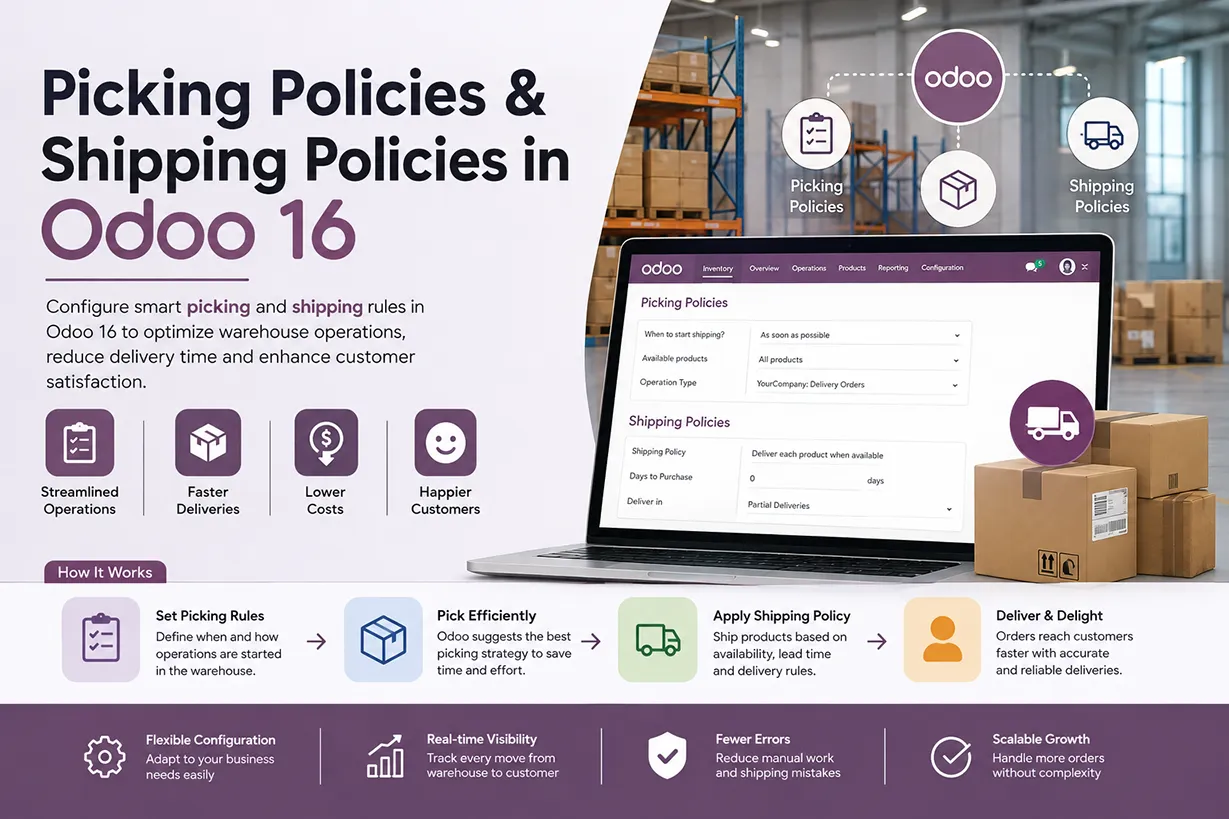
Understanding Picking Policies and Shipping Policies in Odoo 16
Efficient order fulfillment is essential for businesses that sell physical products. From the moment a customer confirms an order, several activities take place in the background. The business needs to check product availability, reserve inventory, pick the required items, pack them correctly, and arrange delivery. Odoo 16 connects these activities through its Sales and Inventory applications, helping businesses create a structured and efficient fulfillment workflow.
The Odoo 16 picking policy determines how a business handles products when all ordered quantities are not immediately available. Meanwhile, the shipping policy controls how products are delivered to customers, including delivery methods, shipping charges, destinations, and carrier options. Together, these configurations help businesses manage order fulfillment more consistently.
For companies handling a growing number of sales orders, these settings can significantly reduce manual work. Instead of making decisions separately for every order, warehouse and sales teams can follow predefined rules. As a result, businesses can improve inventory control, reduce fulfillment errors, and provide customers with clearer delivery expectations.
Why Picking Policies Are Important in Odoo 16
A picking policy determines when Odoo can move an order into the fulfillment stage. This becomes particularly important when a customer purchases several products and one or more items are temporarily unavailable. Without a defined policy, employees may need to decide manually whether to ship available products or wait for the complete order.
Odoo 16 provides a practical way to standardize this decision. Businesses can choose to ship products as soon as they become available or wait until every product in the order is ready. The appropriate choice depends on the company’s inventory strategy, customer expectations, warehouse capacity, and shipping costs.
For example, an e-commerce company may prefer partial shipments because customers usually want available products as quickly as possible. In contrast, a business selling equipment packages may prefer to ship everything together. Therefore, the Odoo picking policy should match the actual fulfillment process rather than follow a one-size-fits-all approach.
How Odoo 16 Supports Order Fulfillment
Odoo 16 integrates sales orders with inventory and warehouse operations. Once a quotation becomes a confirmed sales order, the system can generate the required inventory operations according to the configured workflow. Warehouse employees can then view the products that need to be picked, packed, and delivered.
This integration creates better coordination between sales and warehouse teams. Sales employees can check product availability, while warehouse users can work directly with delivery orders created from confirmed sales. Consequently, businesses can reduce duplicate data entry and improve the accuracy of order information.
The system also provides greater visibility into inventory movements. Users can identify products that are available, reserved, incoming, or waiting for replenishment. Such visibility allows businesses to plan warehouse activities more effectively and respond quickly when stock shortages affect customer orders.
Odoo 16 Picking Policy Configuration
Before selecting a picking policy, businesses should review how they currently manage inventory and customer orders. Consider the average order volume, product availability, warehouse capacity, delivery costs, and customer expectations. These factors can help determine whether partial shipments or complete shipments provide the better operational solution.
A carefully selected Odoo 16 picking policy can also simplify employee workflows. Once the policy is configured, warehouse employees can follow a consistent process when they encounter products that are not available in the required quantity. This consistency reduces confusion and makes order processing easier to manage.
Inventory replenishment also plays an important role. Frequent stock shortages can lead to backorders regardless of the selected picking policy. Therefore, businesses should review minimum stock levels, purchase planning, demand forecasting, and replenishment rules alongside their picking configuration.
Choosing the Right Picking Policy for Your Business
Different businesses require different approaches to order fulfillment. A company selling individual consumer products may benefit from shipping available products immediately. Customers receive part of their order sooner, which can improve the overall shopping experience. However, multiple shipments may also increase packaging and transportation expenses.
Waiting for all products to become available can make more sense for businesses that sell product bundles, machinery, equipment, or complete project kits. In such cases, customers may expect everything to arrive together. The business can therefore avoid splitting one order into several deliveries.
Another important consideration is the cost of backorders. If partial fulfillment creates frequent additional shipments, the company should compare the extra logistics cost with the benefit of faster delivery. By reviewing these factors before configuring Odoo 16 inventory management, businesses can select a workflow that supports both customer satisfaction and operational efficiency.
Understanding Shipping Policies in Odoo 16
A shipping policy defines how products move from the warehouse to the customer. While a picking policy focuses mainly on product availability and fulfillment timing, a shipping policy covers delivery options, shipping costs, delivery providers, destinations, and customer communication.
With Odoo 16 shipping management, businesses can configure multiple delivery methods according to their operational requirements. Standard delivery, express shipping, local delivery, and carrier-based services can all form part of an organized shipping strategy.
Clear shipping policies also improve transparency during the sales process. Customers can understand the available delivery options and associated costs before completing their orders. This clarity can reduce unexpected charges and delivery-related questions after the purchase.
Shipping Methods and Delivery Management in Odoo 16
Odoo 16 allows businesses to create shipping methods that connect sales orders with delivery operations. A shipping method can include information such as the provider, delivery product, company, website, pricing, and destination availability.
Businesses can create different delivery options for different customer requirements. For instance, standard delivery can serve price-sensitive customers, while express delivery can support customers who need their orders quickly. Offering suitable options gives customers greater flexibility while allowing the business to control its logistics process.
Shipping charges can also be configured according to the business model. A company may use a fixed shipping price or provide free delivery when an order exceeds a specified value. Such pricing strategies can support both customer acquisition and order value growth.Your existing Shipping Policies and Shipping Method configuration section remains here unchanged.
How Picking and Shipping Policies Work Together in Odoo 16
Picking and shipping policies are closely connected because both influence the complete order fulfillment process. The picking policy determines when products can move forward for fulfillment, whereas the shipping method determines how those products reach the customer.
Consider an order containing five products. Four items may be available in the warehouse while the fifth item is waiting for replenishment. Depending on the selected Odoo 16 picking policy, the business can either ship the available products immediately or wait until the complete order becomes available.
Once the products are ready, the configured shipping method determines the delivery option. The customer may receive standard shipping, express delivery, or another available service. Therefore, both policies should work together to create a smooth process from sales order confirmation to final delivery.
This integration becomes even more valuable for businesses operating multiple warehouses or sales channels. A centralized workflow allows teams to maintain better visibility while reducing unnecessary manual coordination.
Benefits of Odoo 16 for Picking and Shipping Management
Odoo 16 brings sales, inventory, warehouse operations, and delivery management into one ERP platform. Instead of maintaining disconnected processes, businesses can connect order fulfillment activities through a centralized system.
Better inventory visibility is one of the major benefits. Sales teams can review product availability before confirming orders, while warehouse employees can access delivery operations directly from the Inventory application. This connection helps reduce communication gaps between departments.
Furthermore, Odoo can help improve picking accuracy. Barcode-based warehouse operations allow employees to identify products and locations quickly. As a result, businesses can reduce manual entry and minimize errors during order preparation.
Customer communication can improve as well. Businesses can configure email and SMS notifications to keep customers informed about order and delivery progress. Providing timely updates helps customers understand what happens after they place an order.
Improve Warehouse Efficiency with Odoo Inventory
Warehouse efficiency directly affects fulfillment speed, operating costs, and customer satisfaction. When employees struggle to locate products or process delivery orders, even a well-performing sales team can face delays.
Odoo Inventory helps businesses organize warehouse operations by connecting stock movements with sales, purchasing, and delivery activities. Companies can configure warehouse locations, routes, operation types, and replenishment processes according to their operational requirements.
Barcode operations can further simplify warehouse activities. Employees can scan products and locations instead of entering information manually. This approach speeds up picking activities and reduces the possibility of selecting the wrong product.
As order volumes increase, structured warehouse workflows become increasingly important. A properly configured Odoo inventory system can help businesses maintain operational control while processing more orders.
Odoo 16 Shipping Integration for E-Commerce
E-commerce businesses need a reliable connection between their online store, inventory, sales orders, and delivery operations. Odoo 16 can connect these processes so that customer orders move through a defined fulfillment workflow.
Once a customer selects a delivery method, the applicable shipping charge can be added to the sales order. The warehouse team can then process the associated delivery order using the selected shipping method. This reduces the need for employees to manage delivery information separately.
Shipping integration can become particularly valuable when order volumes increase. Manual shipping management takes more time and creates additional opportunities for data-entry errors. An integrated workflow can help businesses process orders more consistently.
Multiple shipping options can also support different customer expectations. Some customers prioritize low delivery costs, while others value faster delivery. Providing suitable choices can therefore create a better e-commerce experience.
Managing Backorders with Odoo 16
Backorders occur when a business receives an order but does not have enough inventory to fulfill the complete quantity. This situation can affect delivery schedules and customer satisfaction, especially when stock shortages occur frequently.
The selected Odoo 16 picking policy determines how the business handles these situations. When the company allows partial fulfillment, available products can move forward while the remaining quantities stay pending. Once new inventory arrives, the remaining products can continue through the fulfillment process.
However, partial fulfillment is not always the best solution. Multiple shipments can increase packaging and transportation costs. For this reason, businesses should compare customer expectations with logistics expenses before selecting their preferred fulfillment strategy.
Improved replenishment can also reduce backorders. By monitoring inventory levels and purchasing requirements, businesses can maintain more appropriate stock quantities. Consequently, the picking policy can work together with broader inventory planning instead of acting as an isolated configuration.
Improve Customer Experience with Better Shipping Policies
Customers expect businesses to provide clear information about delivery costs and estimated delivery times. A well-defined shipping policy helps meet these expectations by explaining the available delivery options before the customer confirms an order.
Odoo 16 can display shipping methods during the sales process. Customers can therefore understand the applicable delivery charges and select the option that best suits their requirements. Clear information at this stage can reduce misunderstandings later.
Automated notifications can further improve the experience. Email and SMS confirmations keep customers informed about order progress and delivery activities. In turn, customers have greater visibility without needing to contact the business for routine updates.
Businesses should review shipping performance regularly. Delivery delays, unexpected charges, frequent returns, or customer complaints may indicate that the current shipping configuration needs improvement.
Best Practices for Odoo 16 Picking and Shipping Configuration
A successful configuration starts with understanding the actual business workflow. Before changing settings, document how orders are received, how inventory is reserved, how products are picked, how items are packed, and how shipments are dispatched.
Next, define clear rules for product availability. Decide whether the business should ship available products immediately or wait for the complete order. Consider delivery commitments, product categories, warehouse capacity, and transportation costs when making this decision.
Shipping methods should also reflect customer requirements. Businesses can create different delivery options when necessary and apply appropriate pricing rules. Destination restrictions should receive particular attention when the company serves multiple regions or countries.
After implementation, performance should be monitored. Important indicators include order processing time, picking accuracy, backorder frequency, shipping cost, delivery delays, and return rates. Reviewing these metrics helps businesses identify bottlenecks and continuously improve their Odoo warehouse management process.
Odoo ERP Implementation for Inventory and Logistics
Implementing Odoo successfully requires more than activating individual settings. Businesses should first map their existing sales, inventory, warehouse, and shipping processes. After that, the Odoo workflow can be configured around those requirements.
An experienced Odoo ERP implementation partner can help businesses review their processes and identify suitable configurations. The implementation team can assist with inventory setup, warehouse operations, picking policies, delivery methods, shipping integrations, user access, and employee training.
Businesses with more complex requirements can also consider Odoo customization and integration. For example, an organization may need connections with an e-commerce platform, shipping provider, accounting system, barcode solution, or another business application.
Proper planning reduces implementation problems and makes the transition easier for employees. It also provides a stronger foundation for future growth.
Why Choose an Odoo Partner for Shipping and Inventory Configuration?
Every business manages inventory differently. A manufacturer may require production-related stock movements, while a distributor may focus on high-volume picking and dispatch. Similarly, an e-commerce company may require multiple delivery options and carrier integrations.
An experienced Odoo partner can study these requirements before configuring the system. The implementation team can then create workflows that match the company’s actual operations rather than forcing employees to adapt to an unsuitable process.
Professional Odoo consulting can also help identify areas for automation. When repetitive inventory and shipping activities are automated, employees can spend more time on higher-value operational tasks.
Ongoing support is equally important. As the business grows, its warehouses, product range, sales channels, and delivery requirements may change. Regular Odoo optimization can ensure that the ERP system continues to support these evolving requirements.
Conclusion: Streamline Picking and Shipping with Odoo 16
Picking policies and shipping policies play an important role in the Odoo 16 order fulfillment process. Together, they help businesses manage product availability, warehouse operations, backorders, delivery methods, shipping costs, and customer communication.
The right configuration can make order processing more predictable and efficient. Businesses can decide how to handle partial inventory, configure suitable delivery methods, connect shipping services, and provide customers with better delivery information.
Odoo 16 also connects Sales and Inventory operations, giving businesses greater visibility throughout the fulfillment cycle. From sales order confirmation to warehouse picking and final delivery, teams can work with connected information instead of relying on separate manual processes.
Whether you operate an e-commerce store, manufacturing company, wholesale business, distribution company, or retail organization, Odoo 16 inventory management can support a more structured fulfillment process. With proper configuration and regular optimization, businesses can improve warehouse efficiency while maintaining better control over inventory and shipping.
If you are planning an Odoo ERP implementation, upgrading your inventory workflow, or configuring picking and shipping policies, an experienced Odoo partner can help you build a solution around your business requirements. Infintor Solutions provides Odoo implementation, customization, integration, migration, consulting, development, support, and maintenance services to help businesses build scalable ERP workflows.