
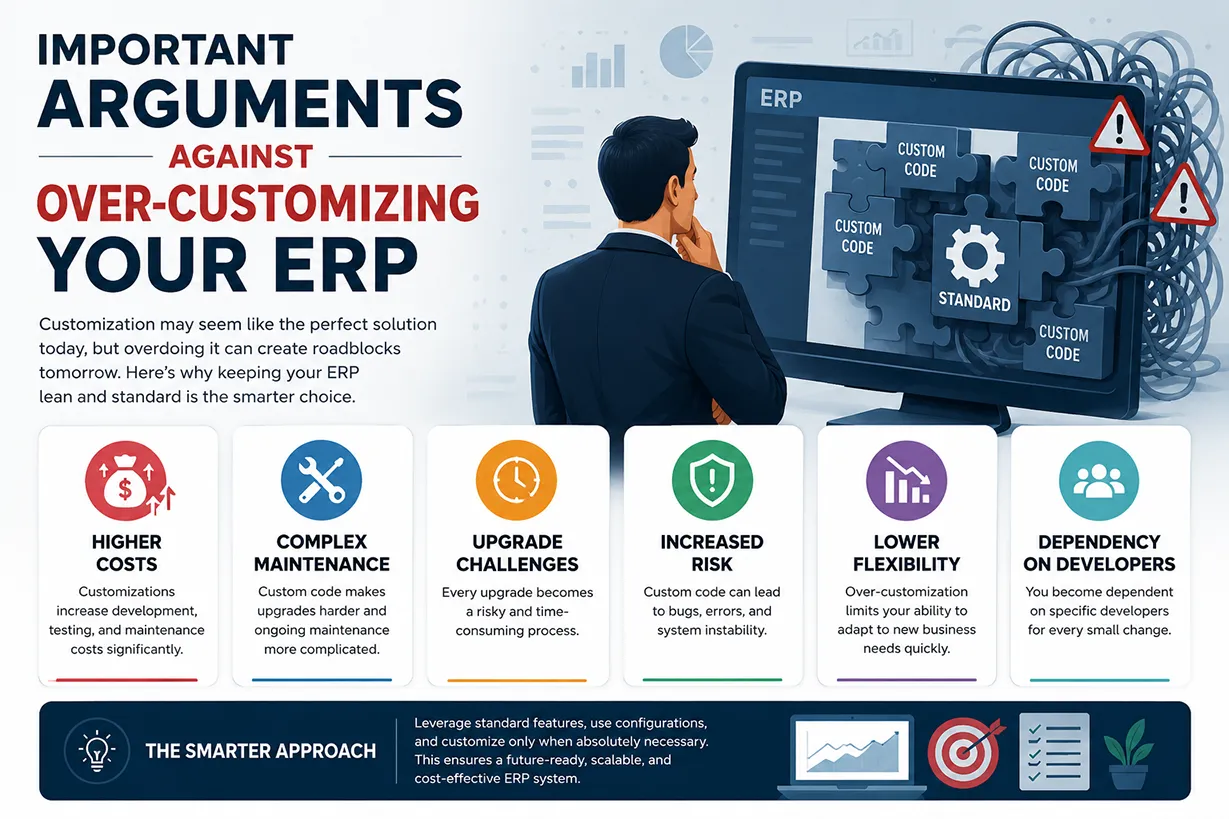
ERP customization can help a business adapt its ERP software to specific processes, reporting requirements, workflows, and industry needs. However, customization should always support a clear business objective. When companies customize an ERP system simply because an existing feature works differently from their preferred process, they can introduce unnecessary complexity. Therefore, businesses should carefully evaluate whether they need a custom solution or whether they can adapt their existing workflow to the standard ERP functionality.
During ERP implementation, teams often discover differences between their existing processes and the standard features offered by an ERP system. At this stage, customization may appear to be the easiest solution. However, changing the software every time a process differs can increase implementation costs, testing requirements, maintenance work, and future upgrade challenges. Instead, businesses should first determine whether the standard ERP workflow can meet the requirement with minor configuration or process improvements. This approach can make the ERP implementation more efficient while keeping the system flexible for future growth.
ERP Customization vs. ERP Configuration
It is important to understand the difference between ERP configuration and ERP customization before making implementation decisions. Configuration usually involves using the existing capabilities of the ERP software to adjust settings, workflows, user permissions, reports, fields, and other options. In contrast, ERP customization changes or extends the standard functionality through additional code, custom modules, integrations, or modified workflows.
For many businesses, configuration should come before customization. Modern ERP platforms such as Odoo provide a wide range of standard applications and configurable features for sales, CRM, accounting, inventory, manufacturing, purchase, human resources, projects, and other business operations. Consequently, an Odoo ERP implementation can often meet a significant portion of business requirements without extensive development. When a genuine business requirement cannot be handled through standard functionality or configuration, targeted Odoo customization can then provide a more practical solution.
How Over-Customization Increases ERP Implementation Costs
One of the biggest concerns with excessive ERP customization is the impact on the overall ERP implementation cost. Custom development requires additional analysis, programming, testing, documentation, deployment, and ongoing support. Furthermore, every custom feature needs to work correctly with the rest of the ERP system. As the number of customizations increases, the implementation team must spend more time validating different processes and business scenarios.
The initial development cost is only one part of the equation. Businesses also need to consider the long-term cost of maintaining customized ERP software. A custom module may require updates when the ERP platform changes, while custom integrations may need modifications when connected systems introduce new APIs or functionality. Therefore, companies should evaluate the total cost of ownership before approving major ERP customization projects. A solution that looks affordable during the initial implementation may become significantly more expensive over several years.
The Impact of Customization on ERP Upgrades
ERP software continues to evolve as vendors introduce new features, security improvements, performance enhancements, and technical updates. However, extensive customization can make it harder for a business to adopt these improvements quickly. Before upgrading an ERP system, the implementation team may need to review custom modules, integrations, workflows, reports, and database changes to identify potential compatibility issues.
As a result, companies with heavily customized ERP systems may postpone upgrades because they require more planning and testing. Over time, this can create technical debt and make the ERP environment increasingly difficult to manage. A more standardized ERP implementation, combined with carefully selected customization, can make future upgrades easier. In addition, businesses can benefit from new ERP features without rebuilding large parts of their existing system every time the software receives a major update.
When Should You Customize an ERP System?
Not every customization is a bad decision. In fact, strategic ERP customization can provide significant business value when it solves a genuine operational problem or creates a measurable competitive advantage. For example, a company may require a specialized workflow because of its industry, regulatory requirements, unique manufacturing process, or customer service model. In such situations, customization can help the ERP system support the business more effectively.
However, a customization should have a clear purpose and measurable benefit. Before approving development, businesses should ask whether the requirement affects an important business process, whether standard ERP functionality can solve the problem, how frequently users will use the feature, and what the long-term maintenance requirements will be. Most importantly, the business should consider whether the expected benefit justifies the additional ERP customization cost. This simple evaluation can prevent unnecessary development while still allowing important requirements to receive the right technical solution.
Building a Flexible ERP System for Long-Term Growth
A successful ERP implementation should not only solve today’s operational challenges; it should also prepare the business for future growth. As companies expand into new markets, add employees, launch new products, or introduce new business processes, their ERP system must adapt without becoming unnecessarily complicated. For this reason, flexibility should remain a key consideration when planning ERP customization.
A well-planned ERP system combines standard functionality, configuration, integrations, and selective customization. This balanced approach allows businesses to improve their processes while maintaining a manageable technology environment. Moreover, clear documentation and proper development practices can make custom ERP modules easier to maintain and upgrade. Whether a company chooses Odoo ERP or another enterprise resource planning platform, the objective should remain the same: build an ERP environment that supports business growth without creating avoidable technical complexity.
How an ERP Partner Can Help Avoid Over-Customization
An experienced ERP implementation partner can help businesses evaluate customization requirements before development begins. Instead of immediately converting every requested feature into custom code, an ERP consultant can review the existing business process, compare it with standard ERP functionality, and identify opportunities for configuration or process optimization. This analysis can significantly reduce unnecessary development and help businesses achieve a smoother ERP implementation.
At the same time, a professional ERP partner should not recommend standard functionality when a genuine business requirement needs customization. The goal is to find the right balance between standard ERP features and business-specific requirements. With proper planning, businesses can use ERP customization where it delivers real value while avoiding unnecessary modifications that increase implementation costs, upgrade risks, and long-term maintenance requirements.
The Right Balance Between Standard ERP and Customization
Ultimately, the objective of ERP implementation should not be to create the most customized system possible. Instead, businesses should create an ERP system that supports their most important processes efficiently, reliably, and cost-effectively. Standard ERP functionality can provide a strong foundation, while selective customization can address requirements that genuinely differentiate the business or cannot be handled through configuration.
Therefore, companies should treat ERP customization as a strategic decision rather than a default implementation step. By analyzing requirements carefully, prioritizing business value, and considering long-term maintenance and upgrade requirements, organizations can avoid many of the risks associated with over-customizing an ERP system. This balanced approach can help businesses achieve a faster ERP implementation, control costs, simplify future upgrades, and build a more scalable technology foundation.
1. Delayed Go-Live Dates
Excessive ERP customization can push back the implementation of your ERP system, resulting in higher project costs, increased budget estimates, and longer waiting periods before your business can realize its return on investment. During an ERP implementation, every custom feature requires additional planning, development, configuration, testing, documentation, and approval. As a result, adding too many custom requirements can extend the project timeline and delay the ERP go-live date.
A delayed ERP implementation can also affect other areas of your business. Employees may need to continue using existing systems or manual processes while the customized ERP software is being developed. Furthermore, additional development work can increase ERP implementation costs and place greater pressure on internal teams. Therefore, businesses should carefully evaluate each customization request and determine whether the requirement provides enough value to justify the additional time and expense. A strategic approach to ERP customization can help organizations achieve a faster and more predictable implementation.
2. Requiring Extensive Regression Testing
ERP customization can affect multiple parts of an ERP system because business applications often share data, workflows, integrations, and processes. A change made to one module may unexpectedly influence another module or business function. Therefore, customized ERP software requires extensive regression testing to confirm that existing features continue to work correctly after new functionality is introduced.
For example, a customization involving sales orders may affect inventory, invoicing, accounting, purchasing, or reporting processes. Similarly, an Odoo customization may interact with several Odoo applications depending on how the business has configured its workflows. Consequently, every significant customization should undergo appropriate functional, integration, and regression testing before deployment. While testing is essential for any ERP implementation, excessive customization increases the number of scenarios that an implementation team must validate, which can increase both project time and ERP maintenance requirements.
3. Increases the Complexity of ERP Upgrades
Over-customization increases the complexity of upgrading an ERP system. ERP vendors regularly release new versions that introduce improved features, security updates, performance enhancements, bug fixes, and technical improvements. However, businesses with heavily customized ERP software may need to review and modify their custom modules before adopting a new version.
As a result, ERP upgrades can take longer and become more expensive over time. Developers and ERP consultants may need to test custom code, integrations, workflows, reports, and third-party applications to ensure compatibility with the upgraded system. In some cases, businesses may even postpone important ERP upgrades because of the time and cost involved in migrating their custom functionality. Therefore, companies should consider future upgrade requirements before approving extensive ERP customization. Using standard ERP features wherever practical and applying customization only when it provides clear business value can make future upgrades significantly easier.
For businesses using Odoo ERP, this consideration is particularly important because regular Odoo updates can provide new functionality and improvements. A carefully planned Odoo implementation with limited and well-documented customization can help organizations take advantage of future Odoo versions without creating unnecessary technical complexity.
4. You Might Be Forced to Rely Solely on One Vendor
Extensive ERP customization can create strong dependencies on the original implementation partner or development team. When an ERP system contains numerous custom modules, integrations, and unique workflows, another ERP service provider may need additional time to understand the architecture and business logic before taking over the project. This situation can make changing ERP vendors more difficult if the business relationship ends or the company needs a different implementation partner.
Vendor dependency can also increase long-term ERP maintenance costs. If the original development team has extensive knowledge of the custom ERP solution, replacing that team may require significant documentation, technical analysis, and knowledge transfer. Furthermore, businesses may have fewer options when negotiating future support, development, or upgrade costs.
For this reason, companies should maintain clear technical documentation and follow standard development practices when implementing ERP customization. A well-structured ERP system should remain understandable and maintainable even when a different consultant or ERP implementation partner takes over the project. Strategic customization helps businesses retain flexibility while still addressing important operational requirements.
5. Dependence on Specialised Knowledge
Intense ERP customization often requires specialized technical knowledge of the system, custom modules, integrations, databases, workflows, and business logic. If only a small number of employees or developers understand how these custom features work, the organization can become dependent on their knowledge. This dependency can create operational risks when experienced employees leave the company or move to different roles.
Knowledge transfer becomes especially important when businesses use customized ERP software for critical operations. Without proper documentation, a new ERP consultant or internal employee may need significant time to understand the existing customization before making changes. Consequently, even a relatively small modification can become more complicated than expected.
Businesses can reduce this risk by maintaining detailed documentation for custom ERP development, integrations, workflows, and configuration changes. They should also avoid unnecessary modifications that only a few specialists can understand. A well-designed ERP implementation should make business processes easier to manage rather than creating a system that depends heavily on individual technical knowledge.
Why Businesses Should Avoid Unnecessary ERP Customization
While ERP customization can bring important advantages, businesses should carefully consider its potential drawbacks before modifying standard ERP functionality. Custom development can solve specific operational requirements, but unnecessary customization may increase ERP implementation costs, testing requirements, maintenance efforts, and upgrade complexity. Therefore, companies should first determine whether their requirements can be addressed through standard ERP functionality, configuration, workflow changes, or existing applications.
A more standardized and adaptable ERP system can help businesses control costs and meet implementation deadlines. At the same time, standard functionality can make employee training, ERP maintenance, upgrades, and future support easier. This does not mean that businesses should completely avoid customization. Instead, the objective should be to use ERP customization selectively when it provides measurable business value or addresses a genuine requirement that standard functionality cannot efficiently support.
Finding the Right Balance Between ERP Customization and Standard Features
The best ERP strategy is rarely based entirely on standard functionality or extensive customization. Instead, successful ERP implementation requires the right balance between the two. Businesses should identify their most important processes, understand the capabilities of their chosen ERP software, and then determine which requirements genuinely need customization.
An experienced ERP implementation partner can help evaluate these requirements before development begins. At Infintor, we focus on understanding the business process first and then identifying the most practical technical solution. Depending on the requirement, this may involve using standard ERP functionality, configuring an existing workflow, integrating another application, or developing targeted customization. This approach helps businesses avoid unnecessary development while still creating an ERP system that supports their specific operational needs.
How Infintor Helps Businesses Avoid Over-Customization
At Infintor, we understand the delicate balance between ERP customization and maintaining long-term system efficiency. Our approach focuses on finding practical solutions that meet business requirements without unnecessarily changing the core ERP system. By analyzing existing processes and available ERP functionality, we can identify opportunities to simplify workflows before recommending custom development.
Our ERP services can help businesses plan, implement, customize, integrate, upgrade, and maintain their ERP environment with long-term scalability in mind. For companies implementing Odoo ERP, this approach can include evaluating standard Odoo applications before developing Odoo customization. When customization is necessary, the objective is to create a maintainable and scalable solution that can support future business growth.
Strategic ERP Customization for Long-Term Business Growth
The purpose of ERP customization should be to improve business operations, not simply to make an ERP system behave exactly like an old system. When organizations replicate every existing process inside new ERP software, they may carry inefficient workflows and unnecessary complexity into their new system. Therefore, ERP implementation provides an opportunity to review existing processes and identify where standardization can improve efficiency.
By striking the right balance between standard ERP functionality and selective customization, businesses can reduce the risks associated with delayed go-live dates, extensive regression testing, complex ERP upgrades, vendor dependency, and specialized knowledge requirements. In addition, a carefully planned ERP system can remain flexible as the organization expands, introduces new products, enters new markets, or changes its operating model.
The goal should always be a powerful yet manageable ERP solution. Strategic customization can enhance operational efficiency without compromising long-term flexibility, scalability, maintainability, or cost-effectiveness. Businesses that evaluate customization based on its long-term value can build an ERP environment that supports sustainable growth rather than creating unnecessary technical debt.
Choose Strategic ERP Customization with Infintor
Choosing the right level of ERP customization can have a significant impact on the success of an ERP implementation. Businesses should consider not only the immediate benefits of a custom feature but also its impact on implementation time, ERP implementation cost, testing, maintenance, upgrades, vendor flexibility, and future scalability.
Infintor helps businesses navigate the complexities of ERP implementation and ERP customization by focusing on practical, business-driven solutions. Whether you need ERP implementation, Odoo customization, ERP integration, ERP migration, ERP consulting, or ongoing ERP support and maintenance, our approach is designed to help you achieve the functionality you need without unnecessary complexity.
Instead of customizing every part of your ERP system, choose a strategic approach that prioritizes business value, scalability, and long-term efficiency. With the right ERP implementation partner, you can build an ERP solution that supports your current operations while remaining flexible enough to adapt as your business grows.